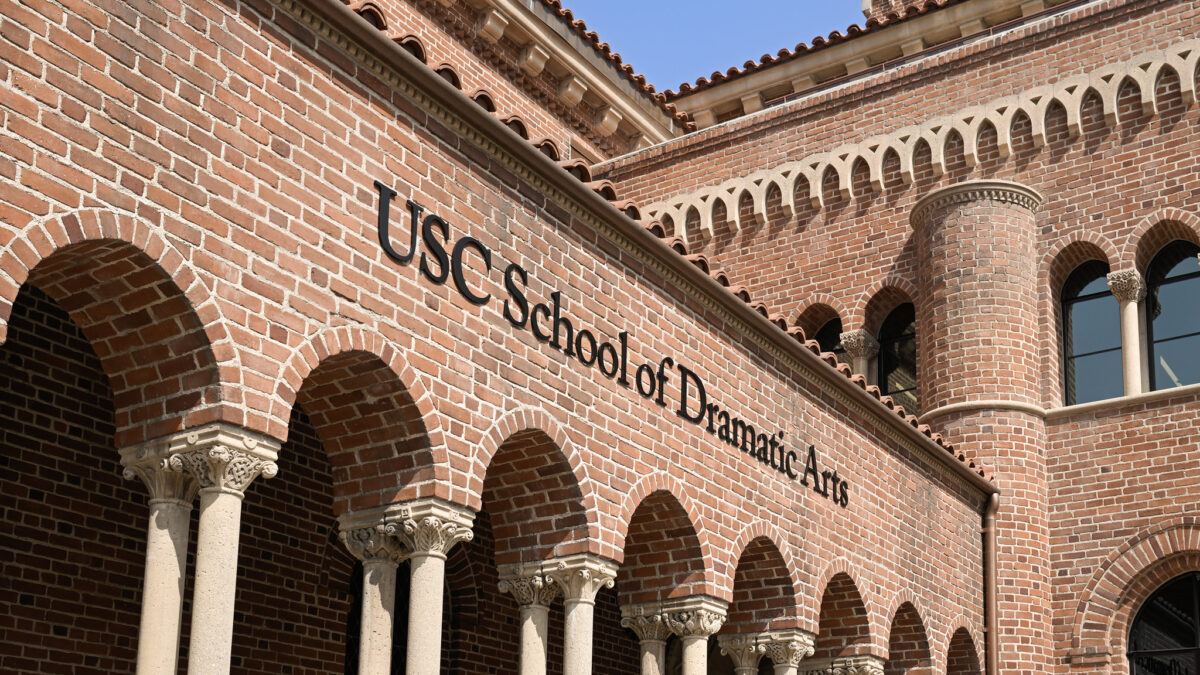
The USC School of Dramatic Arts (SDA) has announced the launch of the USC Institute for Actor-Driven Innovation (USC-IAI), a first-of-its-kind research institute housed in the School’s state-of-the-art Dick Wolf Drama Center. Positioned at the intersection of technological innovation and human creativity, USC-IAI arrives at a pivotal moment. As rapid advances in artificial intelligence (AI) reshape the creative economy, the Institute will empower actors, creators, and professionals across industries to harness these tools, while elevating the irreplaceable human qualities no technology can supersede.
The Institute is the vision of Emily Roxworthy, dean of the USC School of Dramatic Arts, who champions the idea that actor training represents one of the most underutilized frameworks for human development in the modern economy.
“Los Angeles is not only the City of Angels — it is the City of Actors. The USC School of Dramatic Arts has always understood our responsibility to train business-savvy actors and empower them as creatives,” said Roxworthy. “USC-IAI provides a space where performers from the USC community and beyond can learn to harness fast-moving technologies as powerful tools for approaching their careers as entrepreneurial businesses. The Institute’s lab space also invites the next generation of dramatic artists to discover creative new directions now possible through artificial intelligence — directions that academia and big tech have yet to imagine.”
“In both the entertainment industry and actor training programs, artificial intelligence has often been viewed as a divisive and exploitative force,” said Roxworthy. “By connecting creative communities on campus and throughout Los Angeles with powerful tools that can illuminate and amplify the distinctly human qualities actors embody, the Institute arrives with a clear intention: to put creators at the center of how these technologies evolve rather than at the mercy of them.”
The moment has come for the creative community to claim its authority in the age of AI. “Actors have always been master navigators of uncertainty, ambiguity, and the full range of human experience,” said Tomm Polos, Founding Director of the Institute for Actor-Driven Innovation. “In a world increasingly shaped by AI, those capacities are not relics of the past; they are the most vital competencies of the future. USC-IAI is here to put those competencies to work.”
Polos is uniquely positioned to lead this effort. As holder of the Rodric David Chair in Creator Arts and USC’s first full-time faculty appointment in this emerging field, he has pioneered academic frameworks around the creator economy while advising major brands and top creators — and is himself a recognized presence on camera.
Adobe joins USC-IAI as a Founding Sponsor, supporting the Institute’s launch and first two years of programming through collaboration on workshops and initiatives designed to empower creators, actors, and professionals across industries to unlock the power and potential of AI tools.
“At Adobe, we believe AI is a creative partner that amplifies human imagination, not replaces it,” said Amy White, Global Head of Corporate Social Responsibility at Adobe. “As a creator-centric company, we’re focused on helping the next generation harness these tools to expand their opportunities and shape what’s next together. That’s why we’re proud to collaborate with the USC Institute for Actor-Driven Innovation to blend technology and human creativity to empower artists with the skills, tools and agency to lead in the age of AI.”
As it launches this spring, USC-IAI will advance its mission first through AI education and conversation:
- Masterclasses and lab programs positioning dramatic artists as “actorpreneurs,” building AI fluency and future-facing skills through applied experimentation and project-based learning;
- First institution to offer comprehensive AI education to actors, serving both USC and the broader Los Angeles community;
- Industry convenings on AI and the creative economy, uniting artists, executives, and technology experts to build human-centered frameworks and address the risks and opportunities automation presents.
In its second phase, launching this fall, the Institute will expand to include:
- Funded interdisciplinary research, in partnership with industry, foundations, and public agencies, validating how actor training strengthens leadership, creative problem-solving, and collaboration, including within human/AI environments;
- A corporate consulting arm that translates this research into leadership development – equipping executives with the distinctly human skills that set leaders apart as automation transforms the nature of work.
The Institute has already drawn support from executives who understand both the need to offer actors high-tech education and how actor training translates to impact well beyond the stage and screen. Rodric David, a USC School of Dramatic Arts (SDA) alumnus and tech entrepreneur who serves on the USC-IAI advisory board, has become an influential voice on the urgency of this work:
“Most people falsely think that AI is not relevant to them—they’re wrong,” said David. “AI is already impacting every conceivable knowledge function. But what we learned at SDA—presence, authentic human connection, the ability to read a room and adapt in real time—applies to all students, not only those seeking professional careers on a stage. In an AI world, the skills taught by the USC School of Dramatic Arts matter more than ever.”