
DJ Kurs, who has led Los Angeles’ famed Deaf West Theatre since 2012 and shepherded productions like their Tony Award-winning revival of Spring Awakening to Broadway, brings his expertise to the USC School of Dramatic Arts (SDA) this academic year as the Sparks Center for Community and Culture artist-in-residence.
As the Center’s second artist-in-residence—following TeAda Productions, a theatre company centering immigrant and refugee voices—Kurs is working across multiple educational initiatives and SDA productions to expand cultural competencies and introduce American Sign Language (ASL) into theatrical practice and curriculum.
His residency launched in August 2025 with a workshop for SDA faculty and staff on “The Tools We Carry: Access and the Art of Connection,” establishing the foundation for this year’s Sparks Center focus areas of accessibility and cultural literacies. The work quickly moved from theory to practice.
“Deaf and hearing persons share tools of artistic storytelling practices,” said Associate Dean of Community & Culture, Professor Anita Dashiell-Sparks, who brought Kurs to SDA as artist-in-residence. “Combining practices creates another layer of expression and literacy.”
Dashiell-Sparks said the residency is designed for long-term impact. “DJ and I have had a chance to dream and imagine a long-term dynamic,” she said. “We are laying a foundation for how curricula could be created for students to have this collaboration as part of their training.”
That vision is already taking shape across multiple productions and learning opportunities.
This fall, Kurs collaborated with Professor Michele Shay and her cast of MFA actors to weave ASL throughout their production of Pass Over, blending signed and spoken dialogue to create new layers of emotional expression. The play, by Antoinette Nwandu, is a modern take on Waiting for Godot and the Book of Exodus, featuring two young Black men in peril as they seek to escape the confines of their forlorn block.
Professor Shay, who served as director for Pass Over, says she got the idea to incorporate ASL into the production while attending a workshop in Africa. She shared that watching a friend from UC San Diego sign and speak at the same time added an emotional component to his presentation. When she discovered that Kurs would be collaborating with SDA this academic year, she broached the idea of adding ASL to Pass Over.
In September 2025, Shay and Kurs went through the play’s script, identifying places where signing might be appropriate. Shay estimates that about one-fourth of the lines had signing added. Kurs then attended several rehearsals of the play, which held public performances in mid-November 2025, providing feedback to the actors on their signing gestures.
The three actors had little or no experience with ASL, and they discovered this added requirement of the play only after being cast. “The actors were more than willing to take this on,” said Shay. “They were not native ASL signers, and DJ really cared that they did it accurately.”
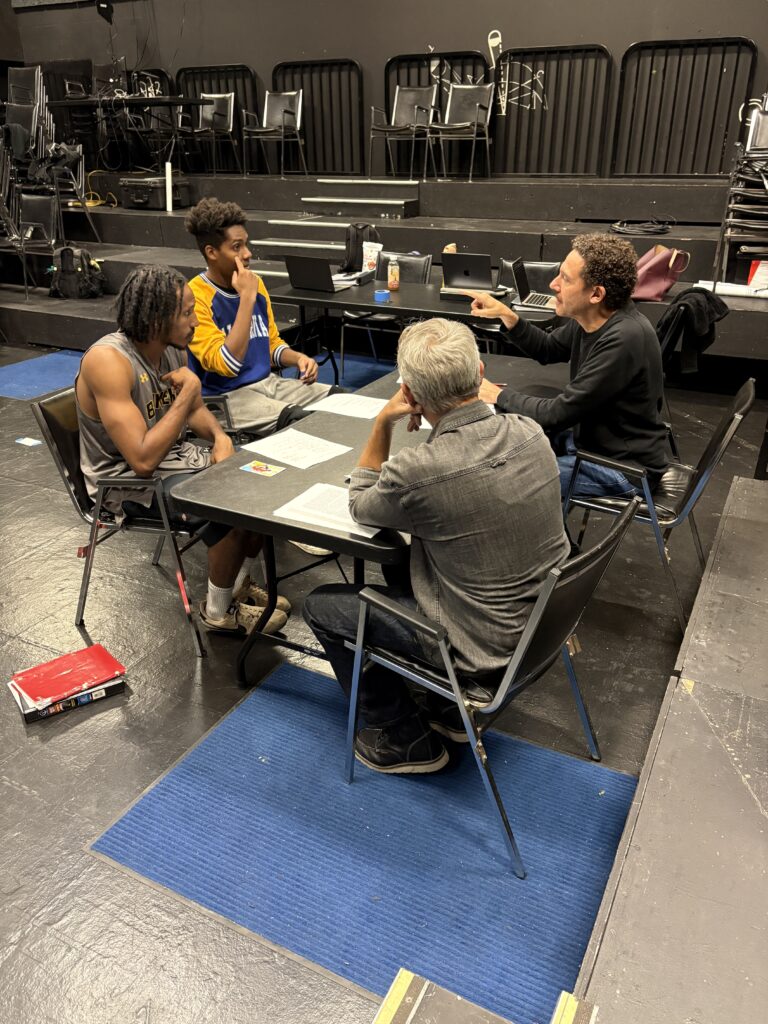
Shawn Anthony, who played the character of Kitch, said he prepared first by studying ASL tutorial videos and recordings of Deaf performers on YouTube. “DJ helped me refine the movements, which require specificity. Similar movements can mean very different things. You have to use your face and take your time.”
The experience of acting with ASL was revelatory for him. “Now I want to learn the language fully,” he said. “There have been people who are hard of hearing since the beginning of time, and I don’t know enough about them. Learning enough to become an interpreter would be amazing.”
Kurs said he and Shay decided that a backstory for the character Moses is that he was a CODA, or child of deaf adults. “Having a deaf parent gave him a foundation,” Kurs said through his interpreter James Foster, who has worked with Kurs for a decade, at a rehearsal. “Moses and Kitch are communicating with ghosts of their pasts.” The choice deepened the play’s exploration of isolation and connection, giving physical form to the characters’ attempts to reach across divides.
Maurice-Aimé Green, who played Moses, said using ASL added an extra layer of nerves to his performance, but ultimately found the challenge deepened his emotional connection to the character.
Kurs was highly complimentary of the commitment the actors made to adding ASL. “The actors are doing a great job with the soundscape of the play and using their bodies to express themselves. It’s a beautiful thing to see.”
A critical element of the production’s cultural authenticity came through the work of Nakia Smith, an expert on Black American Sign Language, who worked with the cast to include signs from that dialect of ASL. The roots are in the same language, but like any dialect, there are exclusive idioms and slang. For example, in Black ASL, the word “tight” means cool, which is not the case in traditional ASL. For a play centered on young Black men’s experiences, this linguistic specificity honored the characters’ cultural identity and avoided a one-size-fits-all approach to accessibility.
The third actor, Kamran Amir, who played the characters of Mister and Ossifer, said he embraced the opportunity to learn a new language. “I think ASL could be incorporated into any play. It can be used in any context, alongside and on top of the text.”
Kurs echoed that thought. “Sign language should be used more in all of the arts.”
His residency ensures he’ll have other opportunities to advance that vision at SDA. Kurs will be collaborating on the musical Working, which Dashiell-Sparks is directing in the spring semester. In coming months, he will also be leading workshops and master classes on infusing ASL into productions and on using nonverbal communication to build stories, relationships and new creative worlds.
The collaboration opens new conversations about accessibility and artistic expression. Through Kurs’ residency, students and faculty are gaining exposure to ASL, broadening their understanding of how stories can be told and how we can create opportunities for more people to experience them.